88888888888888888888888888888888888888888888888888888888888888888888888888888888888888888888888888888888888888
Roshi, Robert Aitken (Robert Baker Aitken)
88888888888888888888888888888888888888888888888888888888888888888888888888888888888888888888888888888888888888
Robert Baker Aitken | |
|---|---|
 | |
| Title | Roshi |
| Personal life | |
| Born | June 19, 1917 |
| Died | August 5, 2010 (aged 93) |
| Spouse | Anne Hopkins Aitken |
| Children | Tom Aitken |
| Education | University of Hawaii University of California |
| Religious life | |
| Religion | Buddhism |
| School | Zen Buddhism |
| Lineage | Harada-Yasutani |
| Senior posting | |
| Teacher | Soen Nakagawa Nyogen Senzaki |
| Predecessor | Yamada Koun |
88888888888888888888888888888888888888888888888888888888888888888888888888888888888888888888888888888888888888
"Everything is contingent upon everything else ....
"People, animals, and other plants flourish, and give themselves in turn. The Buddha suggested that human beings can get along best by following this natural way of things. Giving creates happiness; greed creates misery." (05/05/2022)
88888888888888888888888888888888888888888888888888888888888888888888888888888888888888888888888888888888888888
Robert Baker Dairyu Chotan Aitken Rōshi (June 19, 1917 – August 5, 2010) was a Zen teacher in the Harada-Yasutani lineage. He co-founded the Honolulu Diamond Sangha in 1959 with his wife, Anne Hopkins Aitken. Aitken received Dharma transmission from Koun Yamada in 1985 but decided to live as a layperson. He was a socialist and anarchist who advocated for social justice for homosexuals, women and Native Hawaiians throughout his life, and was one of the original founders of the Buddhist Peace Fellowship.[1][2]
Biography

Robert Aitken or Bob, as he liked to be called, was born to Robert Thomas Aitken and Gladys Page Baker in Philadelphia, Pennsylvania, in 1917. He was raised in Hawaii from the age of five.[3] He was the son of a war enthusiast and was a rebel and loner in the 1930s and 40s before the war.[4]
Living in Guam as a civilian working in construction—at the onset of World War II—he was detained by the Japanese and held in internment camps for the duration of the war. A guard at one of the internment camps let him borrow a copy of R.H. Blyth's book Zen in English Literature and the Oriental Classics. In one of his books later on in his life, he described being so invested in the book that he managed to be joyful even in the terrible conditions.[5] In another internment camp in Kobe, Japan, in 1944 he met its author, Reginald Horace Blyth, with whom he had frequent discussions on Zen Buddhism and anarchism. At the conclusion of the war he returned to Hawaii and obtained a B.A. in English literature and an MA in Japanese from the University of Hawaii. He would write for two hours each morning and even read aloud his work to make sure it was his distinctive style.[6]
In the late 1940s, while briefly attending classes at the University of California in Berkeley, California, he met Nyogen Senzaki.[7] Originally in California hoping for an encounter with Krishnamurti, he began to study with Senzaki in Los Angeles. During this period he became more vocal about his commitment to leftist social issues such as pacifism and labor rights. He was investigated by the FBI as a result of his advocacy work. Aitken decided to not pay the portion of his taxes that went to the Defense Department of the U.S. because he opposed the war in Vietnam and arming the military.[3]
In 1950, Aitken returned to Japan, under a grant to study haiku and followed Senzaki's recommendation that he study Zen.[8] There he took part in his first sesshin at Engaku-ji, a temple in Kamakura, Japan.[8] Soon after, he met Nakagawa Soen, who persuaded him to come for a stay at Ryutakuji for the next seven months. During this period Soen took over for the ailing abbot of the temple, Yamamoto Gempo.[8] Aitken then developed dysentery, and returned home to Hawaii. He married his second wife Anne Hopkins in 1957 and made occasional trips back to Japan. In 1957 Aitken met Hakuun Yasutani and sat with him for the first time.[7][9][10][11][12]
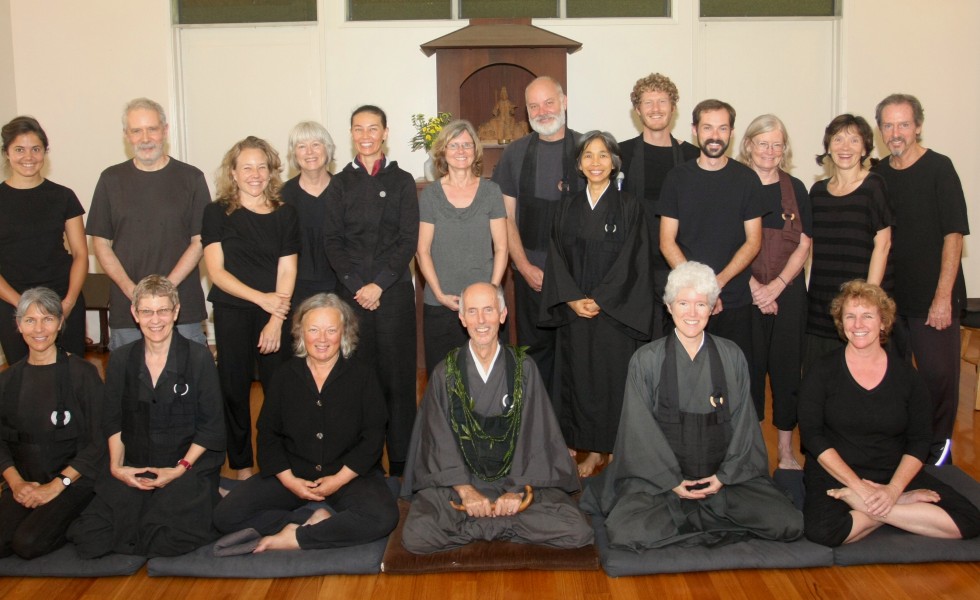
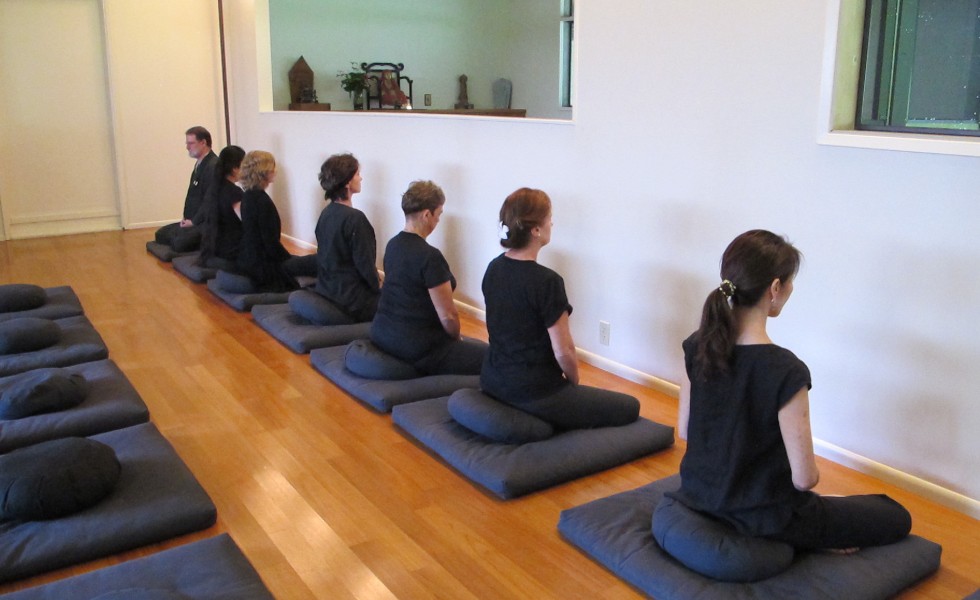
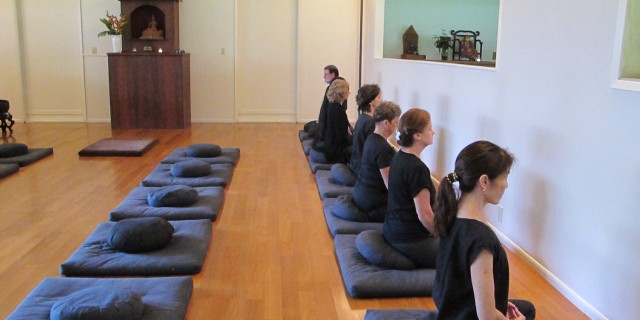
In 1959 he and Anne began a meditation group in Honolulu at their residence, which became known as the Koko-an zendo. The community that gathered at this zendo were then named the Diamond Sangha by the two. The Diamond Sangha has affiliate zen centers in South America, Australia, New Zealand, the United States and Europe and is known for making the rigors of traditional Zen accessible to lay practitioners.[13][14]
In 1960 Soen Nakagawa Roshi asked young monk Eido Tai Shimano to travel to Honolulu to assist at the Diamond Sangha center.[15]
In 1961, Aitken made an extended stay in Japan to study under Haku'un Yasutani, eventually ending his studies with Soen. He then worked in various capacities at the East-West Center and the University of Hawaii until 1969, when he and Anne moved to Maui, Hawaii, to found the Maui Zendo in Haiku-Pauwela. Koun Yamada Rōshi was invited to lead the Diamond Sangha and he moved to Hawaii in 1971. In 1974 Aitken was given permission to teach by Koun Yamada, receiving full Dharma transmission from him in 1985.[7][16]
He also was a major inspiration for the ‘System Stinks’ movement, where they drew inspiration from his famous photograph protesting with a sign. In the picture the sign said 'The System Stinks' and was in protest of the Iraq War, while in his wheelchair. The photo was taken in Hawaii.[17]
Robert Aitken was a social activist through much of his adult life, beginning with protesting against nuclear testing during the 1940s. He was an outspoken critic of the Vietnam War, and became a strong opponent of the nuclear arms race between the United States and the Soviet Union. He was among the earlier proponents of deep ecology in religious America, and was outspoken in his beliefs on the equality of men and women. In 1978 Aitken helped found the Buddhist Peace Fellowship, an organization that advocates conflict resolution globally. In the discussion that led to the founding of the Buddhist Peace Fellowship, most of the other people had less experience than him when it came to political activism. This gave him the most influence on what the organization should be about. Many of the first 100 people who were sent invitations to join were recommendations from Robert Aitken.[4] He was also the guest speaker at the first two institutes that the Buddhist Peace Fellowship held. He did have anarchist beliefs, which is why even when he helped found the organization, he didn't take any control due to distrusting all authority or control even when it was his own.[4]
Aitken Roshi retired in 1996 and spent some of his final years in Palolo, Hawaii, where he could be looked after and interact with some of his students.[18] He died after a brief bout with pneumonia on August 5, 2010, in Honolulu, Hawaii. He was working on his fourteenth book before his passing.[19]
Bibliography
- Zen Training. A Personal Account; Honolulu: Old Island Books (1960).
- A Buddhist Reader; Honolulu: Young Buddhist Association (1961).
- Hawaii Upward Bound Writing and Art 1966; A Project of the Office of Economic Opportunity. Robert Aitken, Editor (1966).
- A Zen Wave: Basho's Haiku and Zen; New York: Weatherhill (1978). ISBN 0-8348-0137-X
- Taking the Path of Zen; San Francisco: North Point Press (1982). ISBN 0-86547-080-4.
- The Mind of Clover: Essays in Zen Buddhist Ethics; San Francisco: North Point Press (1984). ISBN 0-86547-158-4.
- The Gateless Barrier: The Wu-menkuan (Mumonkan); San Francisco: North Point Press (1990). ISBN 0-86547-442-7.
- The Dragon who Never Sleeps: Verses for Zen Buddhist Practice; Berkeley: Parallax Press (1992). ISBN 0-938077-60-0.
- Encouraging Words: Zen Buddhist Teachings for Western Students; San Francisco and New York: Pantheon Books (1993). ISBN 0-679-75652-3.
- The Ground We Share: Everyday Practice. Buddhist and Christian with David Steindl-Rast; Ligouri, Missouri: Triumph Books, (1994). ISBN 0-89243-644-1.
- The Practice of Perfection: The Paramitas from a Zen Buddhist Perspective; San Francisco and New York: Pantheon Books (1994). ISBN 0-679-43510-7.
- Original Dwelling Place: Zen Buddhist Essays; Washington, DC: Counterpoint Press (1996). ISBN 1-887178-16-3.
- Zen Master Raven: Sayings and Doings of a Wise Bird; Boston: Tuttle Publishing (2002). ISBN 0-8048-3473-3
- A Zen Master: Counterpoint 2008 ISBN 978-1-58243-536-7
See also
- Buddhism in the United States
- Buddhism in the West
- Buddhist Peace Fellowship
- Engaged Buddhism
- List of peace activists
- Timeline of Zen Buddhism in the United States
References
- Seager, Richard Hughes (1999). Buddhism in America. Columbia University Press. p. 95. ISBN 0-231-10868-0.
- Woo, Elaine (August 10, 2010). "Robert Aitken dies at 93; American Zen master". Los Angeles Times. Archived from the original on May 6, 2015. Retrieved April 15, 2015.
- Kahn, Roshi Paul Genki (March 2011). "Remembering Robert Aitken Roshi". Tricycle: The Buddhist Review. Archived from the original on 2021-05-01. Retrieved 2021-05-01.
- Queen, Christopher S (2000). Engaged Buddhism in the west. Boston, MA: Wisdom Publications. ISBN 978-0-86171-841-2. OCLC 955611187.
- "Robert Aitken dies at 93; American Zen master". Los Angeles Times. 2010-08-10. Archived from the original on 2019-03-20. Retrieved 2021-05-01.
- "Robert Aitken Roshi — A Personal & Biographical Reflection". Clear View Project. 2010-08-24. Archived from the original on 2020-09-09. Retrieved 2021-05-02.
- Prebish, Charles S (1999). Luminous passage: the practice and study of Buddhism in America. University of California Press. pp. 19, 20, 21. ISBN 0-520-21697-0. Archived from the original on 2024-06-03. Retrieved 2020-10-16.
- Fields, Rick (1992). How the Swans Came to the Lake: A Narrative History of Buddhism in America. Shambhala Publications. pp. 201–202. ISBN 0-87773-631-6.
- Yasutani, Hakuun (1996). Flowers Fall: A Commentary on Zen Master Dogen's Genjokoan. Shambala. pp. XXVI. ISBN 1-57062-103-9. Archived from the original on 2024-06-03. Retrieved 2020-10-16.
- Wenger, Michael (2001). Wind Bell: Teachings from the San Francisco Zen Center (1968-2001). North Atlantic Books. p. viii. ISBN 1-55643-381-6.
- Aitken, Robert, Merwin, W.S. (2003). A Zen Wave: Basho's Haiku and Zen. Shoemaker & Hoard Publishers. p. xi, xii. ISBN 1-59376-008-6.
- Queen, Christopher S (2000). Engaged Buddhism in the West. Wisdom publications. pp. 70–73. ISBN 0-86171-159-9.
- "Honolulu Diamond Sangha". Archived from the original on 2019-06-29. Retrieved 2010-02-04.
- "Affiliates of the Diamond Sangha". Archived from the original on 2010-01-10.
- Ford, James Ishmael (2006). Zen Master Who?: A Guide to the People and Stories of Zen. Wisdom Publications. p. 114. ISBN 0-86171-509-8. Archived from the original on 2024-06-03. Retrieved 2024-06-03.
- Chappell, David W (2000). Buddhist Peacework: Creating Cultures of Peace. Wisdom Publications. p. 93. ISBN 0-86171-167-X.
- Baroni, Helen (March 5, 2017). "The System Stinks: Sources of Inspiration for the Buddhist Peace Fellowship" (PDF). Archived (PDF) from the original on May 1, 2021. Retrieved May 2, 2021.
- "About Us |". Archived from the original on 2021-05-01. Retrieved 2021-05-01.
- The Christian Century, 127 no 18 Sep 07 2010, p 19
88888888888888888888888888888888888888888888888888888888888888888888888888888888888888888888888888888888888888

Robert Aitken Quotes
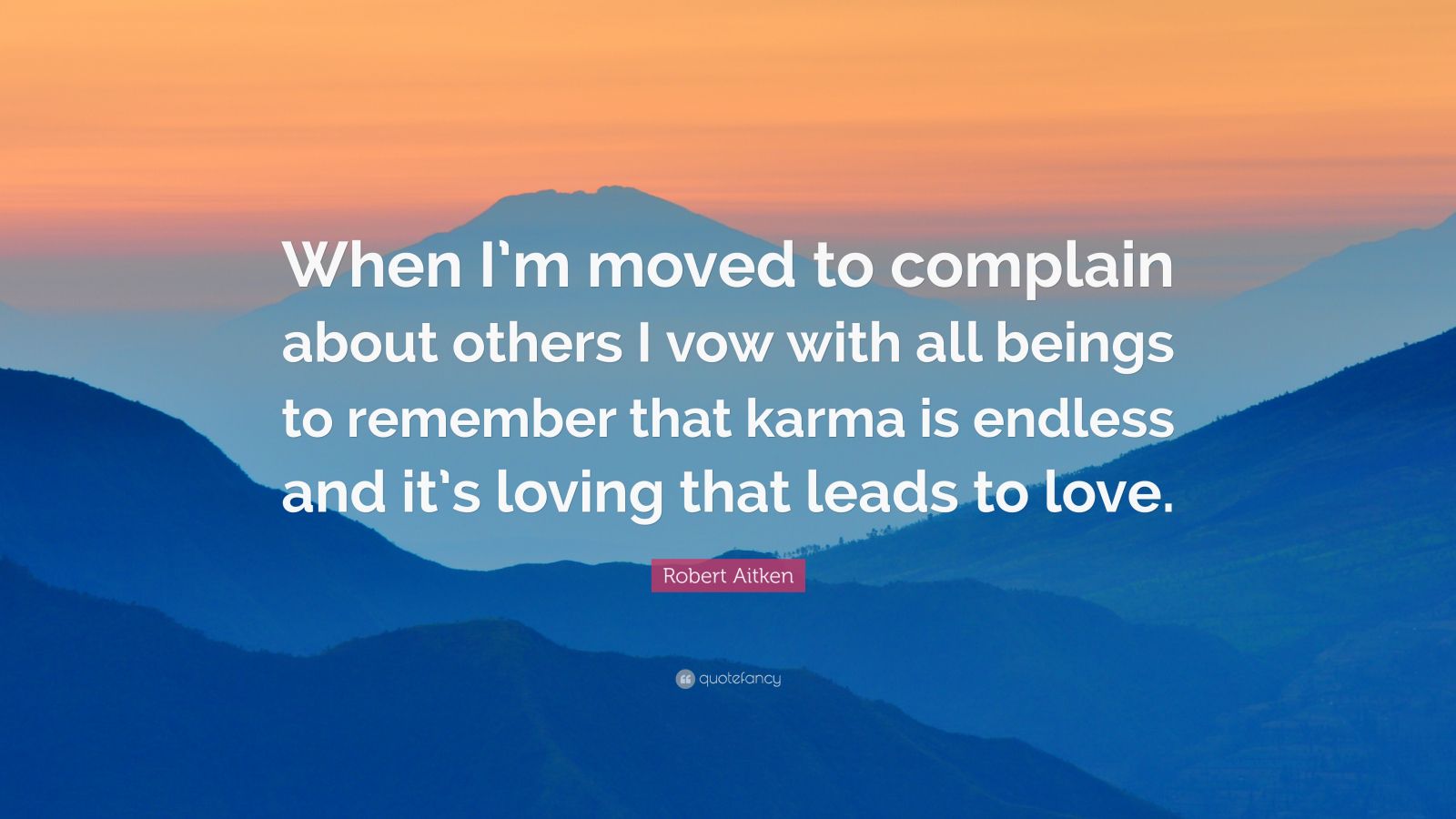
Robert Baker Aitken Rōshi (1917–2010) was a Zen teacher in the Harada-Yasutani lineage, known for his teachings on impermanence, interdependence, and compassionate action. Here are some of his most notable quotes:
On renunciation: “Renunciation is not getting rid of the things of this world, but accepting that they pass away.” A-Z Quotes+1
On practice and mystery: “Our practice is not to clear up the mystery. It is to make the mystery clear.” A-Z Quotes
On the Buddha’s teaching: “The Buddha’s original teaching is essentially a matter of four points — the Four Noble Truths: 1. Anguish is everywhere. 2. We desire permanent existence of ourselves and for our loved ones, and we desire to prove ourselves independent of others and superior to them. These desires conflict with the way things are: nothing abides, and everything and everyone depends upon everything and everyone else. This conflict causes our anguish, and we project this anguish on those we meet. 3. Release from anguish comes with the personal acknowledgment and resolve: we are here together very briefly, so let us accept reality fully and take care of one another while we can. 4. This acknowledgement and resolve are realized by following the Eightfold Path: Right Views, Right Thinking, Right Speech, Right Conduct, Right Livelihood, Right Effort, Right Recollection, and Right Meditation. Here ‘Right’ means ‘correct’ or ‘accurate’ — in keeping with the reality of impermanence and interdependence.” Goodreads
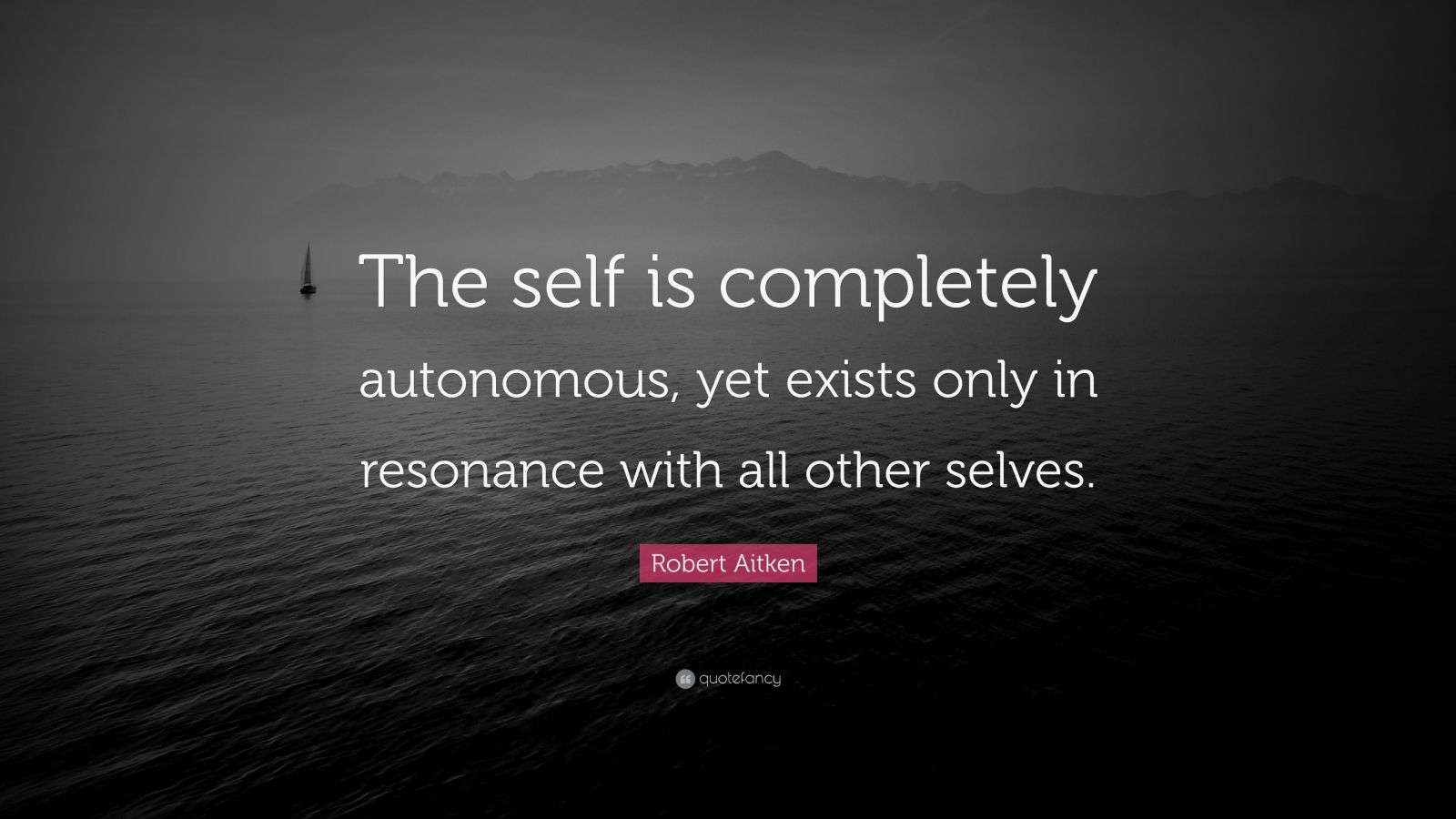
On the self: “The self is completely autonomous, yet exists only in resonance with all other selves.” QuoteFancy
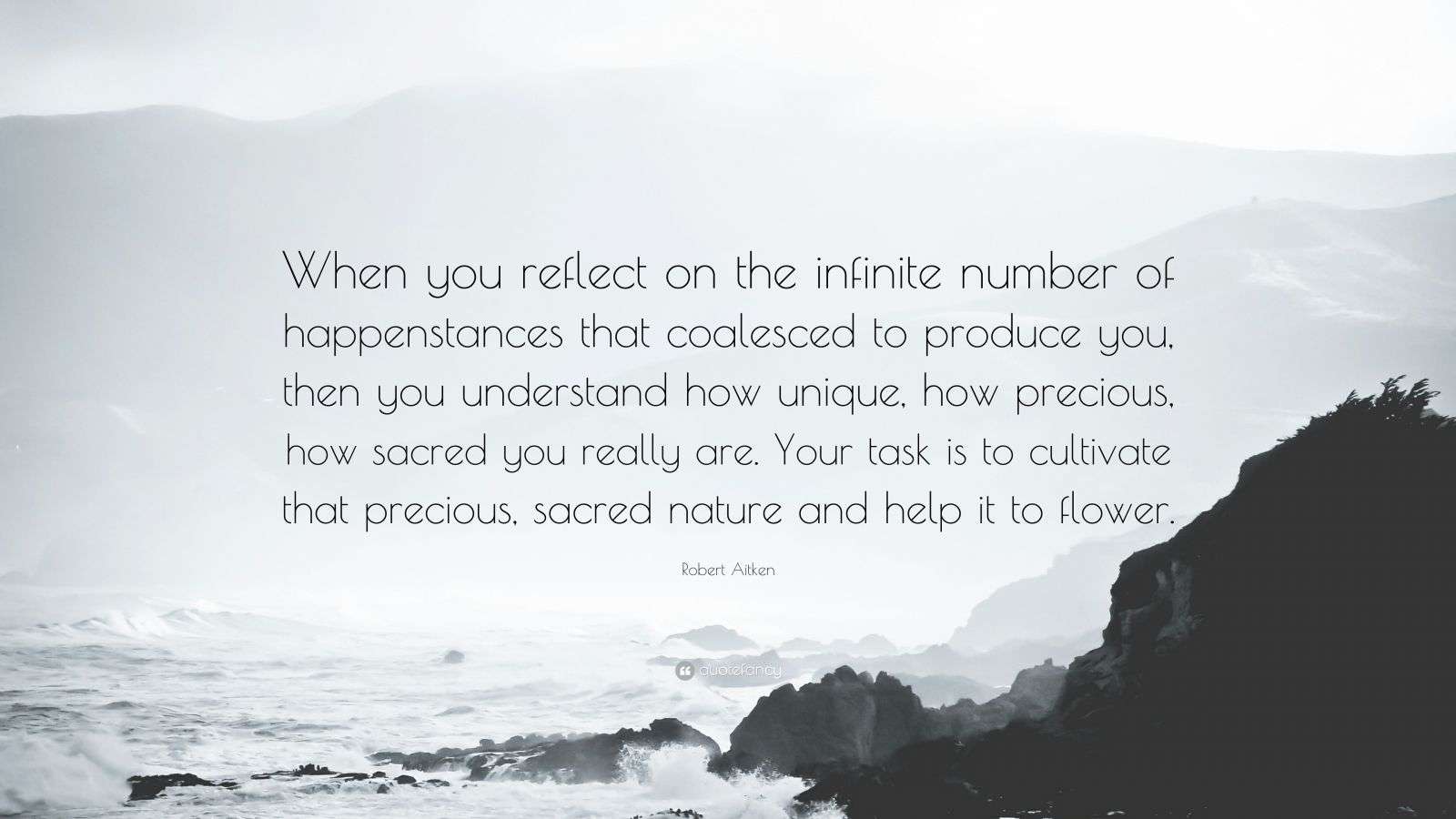
On uniqueness and sacredness: “When you reflect on the infinite number of happenstances that coalesced to produce you, then you understand how unique, how precious, how sacred you really are. Your task is to cultivate that precious, sacred nature and help it to flower.” QuoteFancy
On mountains and stillness: “Once one thinks like a mountain, the whole world is converted. All things confirm me. Then I sit on dojo cushions that do not move. There is no controller and no one to control.” QuoteFancy
On stars and interdependence: “You and I come forth as possibilities of essential nature, alone and independent as stars, yet reflecting and being reflected by all things. My life and yours are the unfolding realization of total aloneness and total intimacy.” QuoteFancy
These quotes reflect Aitken’s deep integration of Zen practice with social justice, environmental awareness, and the recognition of our interconnectedness.
88888888888888888888888888888888888888888888888888888888888888888888888888888888888888888888888888888888888888





88888888888888888888888888888888888888888888888888888888888888888888888888888888888888888888888888888888888888
88888888888888888888888888888888888888888888888888888888888888888888888888888888888888888888888888888888888888

88888888888888888888888888888888888888888888888888888888888888888888888888888888888888888888888888888888888888888

No comments:
Post a Comment